Saturday, April 20, 2013

The Road to Sur

Sorry for the absence guys, I have so much to catch up on both on my blog and in real life. I'll start with our trip to Ras Al Jinz, a place south of Muscat known for being the birthplace of thousands of giant sea turtles every year. It's a decently long drive so we made a lot of stops along the way.
The first was Wadi Aarbaeen an aquamarine jewel hiding behind a respectably steep mountain --I don't think I will ever get used to the kind of crazy driving involved with scaling these Omani mountains.

We stopped by the beach in Fins to swim then headed to the nearby sinkhole-park. I'd been here earlier with my family an it's an awe-inspiring sight every time, looking from above, swimmers look like ants swishing about in a vast blue dent in the earth. 
After swimming, lunch and lots of driving we stopped in Sur proper for some kymaat (Omani sweet you get at tiny coffeeshops to eat with chai or kahwa--like delicious balls of funnel cake with sesame seeds) and to tour the Dhow factory. By tour I mean walk in randomly and wander around--we then discovered several "wadi dogs" and host of other wildlife which was added to the list of animals we plan on adopting and making official YES pets. The current list goes: goat kid, baby turtle, camel, assorted lizards and snails. We're sure Fatin won't mind making some room in her office for them.


Literally
At  Ras al Jinz we settled into the hotel/wildlife center and soon it was time for the main attraction; introducing The! Pregnant! Turtles! I don't have any pictures of this whole part because you were technically not supposed to have any cameras or light sources which might disrupt the turtles (although that didn't stop quite of a number of furiously-texting/picture-taking tourists). We stood in the dark on the beach at around 11 o'clock, watching a giant sea turtle squeeze out dozens of dough-ball-looking eggs. It felt like a very private, delicate moment for the turtle mama that me and 40-some other Europeans were just standing and gawking at. Seems kind of awkward for the turtle. 


The next morning us girls woke up early so we could  contemplate life while sitting atop boulders and watching the sun rise over ocean.


 We spent the next day first exploring Wadi Bin Khaled, one of the biggest Wadis I've ever seen. Even while cruise-ship-tourist-filled it was gorgeous, and we had a lot of fun cliff diving into the water.


In the afternoon we found the dirt-gravel-low shrub scenery that characterizes much of Muscat turning into a finely sanded, barren expanse, until we were surrounded on all sides by the towering orange-brown dunes of Wahiba. We ate in the house of a Bedouin family who hosts visitors as a business and they let us try on some traditional Bedu clothing.
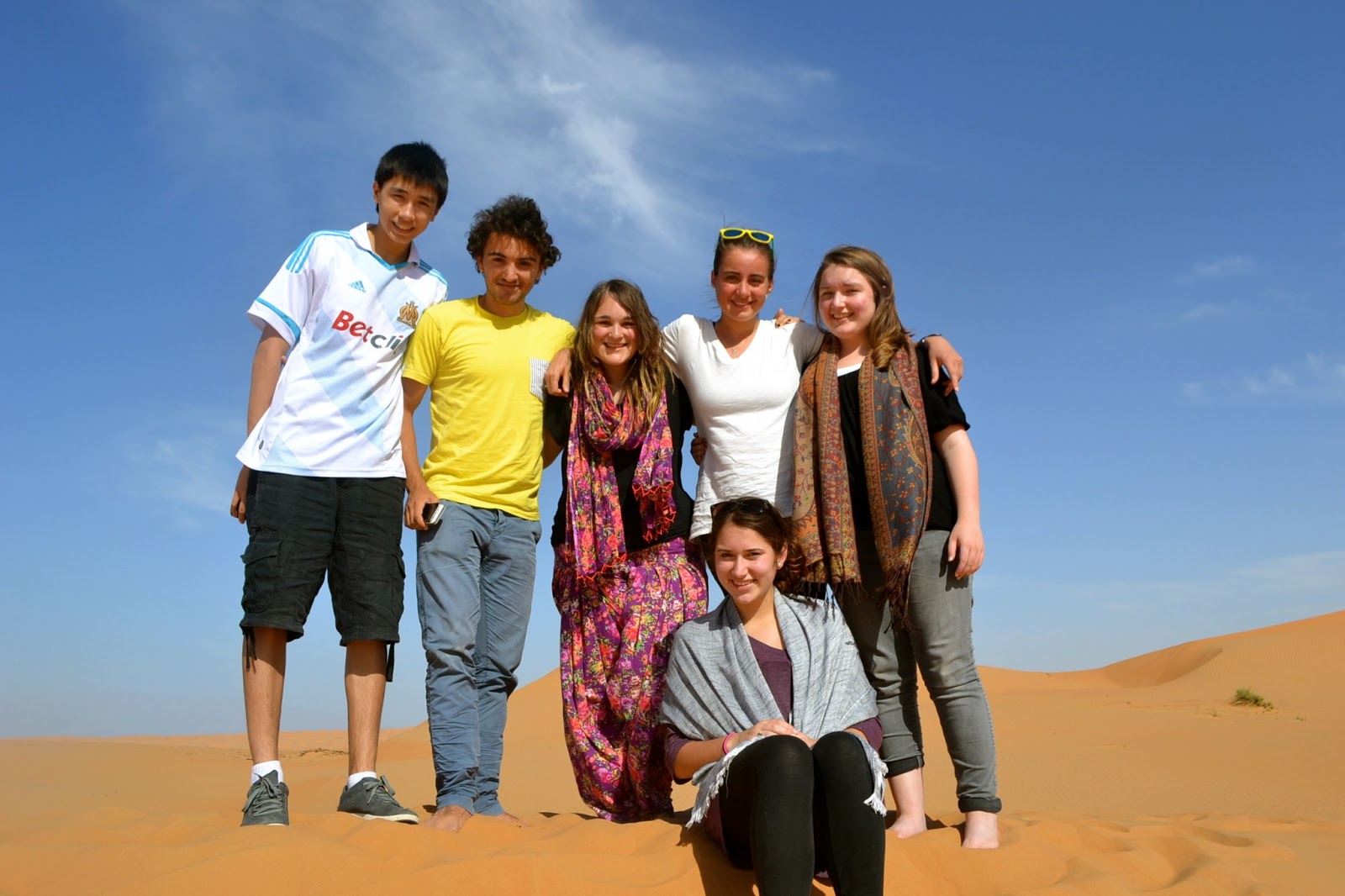
After lolling in the sun, taking the requisite "Look we're jumping in the desert" pictures, and riding some camels (not going to lie, I was completely terrified), we headed back towards Muscat.
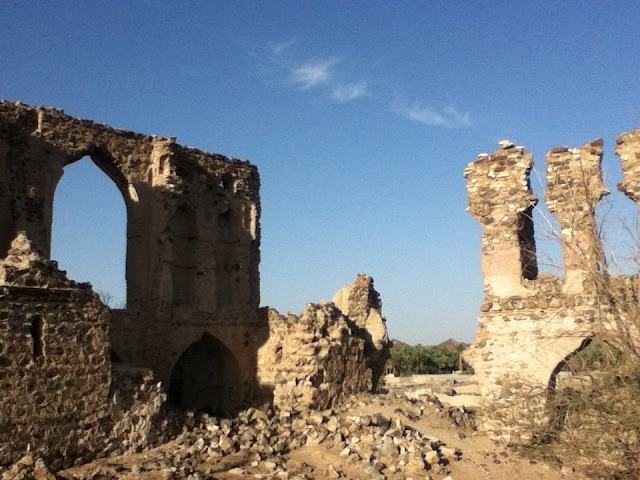
The last and one of the most interesting stops we made was in the city of Ibra, which used to be a major trading hub at the height of the Omani empire. Now many of those grand old buildings have fallen into ruin and we spent some time exploring them.
 

 A couple hours of driving and we were back in Muscat. Venturing outside of Muscat to see Oman's crazy diversity (both in nature and culture) is always amazing, and I loved how this trip let us see so much of the Sharqiyah region. Next post I'll talk about Sohar!
Thursday, March 14, 2013

How to practice Arabic when everyone speaks English

Thanks to my beautiful, totally-not-coerced models Lisa and Ashley
To be honest, sometimes practicing Arabic can be embarrassing, frustrating, and feel totally futile. I often wonder, as I'm surrounded by Omanis speaking perfect English, if I'll ever have linguistic ability above the level of a 5 year old. But if I ever want to stop embarrassing myself with my Arabic, I need to start embarrassing myself with my Arabic more often--that's what this post is about. 

1. Greet people with a Salam Alaykum

Seeing that you're a foreigner, most Omanis will automatically speak to you in English, and it's so easy to go along with it. But returning a "How are You?" with "7umdililah, kayf 7alik?" shows the other person that you want to make the effort, opening the door to a bi-lingual conversation.


2. Practice with shopkeepers
It's much easier to talk to people who are impressed that you know any Arabic at all, so that even though your words are stunted, laboriously produced, and poorly formed, at least they find it cute that you're trying. An uncrowded stall in Muttrah or local coffeeshop are good places to strike up a conversation. But be careful that the person you're chatting with actually speaks Arabic (dishdashas are a good indicator)---one of the funniest scenes I ever saw in Muttrah was caused by a British tourist, wearing a one of those hilarious sexist-joke T-shirts and what looked like the European conception of a "Turban" wrapped around his head. It was around the time that a cruise ship had dropped anchor and unleashed its inhabitants on the old souq. He lumbered into the shop and began speaking loud, formal Arabic at the Bangladeshi store owner--a sad case of assuming brown person = Arabic speaker. Don't be this guy. 

3. Practice with taxi drivers
Oman is one of the few countries in the world where taxi drivers are nations--it's actually a law here. Car rides are good opportunities for low-pressure conversations; it's not too hard to say "I need to go here, take the next right, go straight" etc, and you can always get a driver talking about their family or how much they hate their job. Girls here won't have much opportunity for contact with taxi drivers because the official word is that "taxis are dangerous," but I've had some very entertaining conversations with Talal and Sayid, the highly emotional drivers who take us to after-school classes. 

4. Practice with kids
It's way less intimidating to carry on a conversation with a six year old than with a sixteen year old. Your vocabularies are much closer in scope, and kids are much more accustomed to communicating through pointing. That being said, kinder-gardeners have no qualms about mocking hilarious American accents, but if you're really internalizing criticism from humans who still eat their own boogers, you probably need to reevaluate your life. 

5. Read subtitles
Reading TV subtitles can make even the most boring parade of B-movie romcoms on MBC entertaining. The Arabic they use is very formal, so most of it makes no sense as a translation of casual conversations. Through subtitles I've learned the exclamation "Taban leka!" and other, equally useful phrases. 

Friday, March 8, 2013

Muscat Festival(s)

I recently had the opportunity to go to the Muscat Festival--think state fair with more culture and less sand art. Actually, it was two different fairs, one with my host family that focused on Omani heritage and cultural events, and one with the YES and some Omani girls that was more of the fried-food-and-spinning-rides variety. Also firework displays that happened randomly, spectacularly, and without warning.
At the festival in Al Amerat, there was a mini "village" set up with traditional Omani crafts. Sellers lined the way with everything from tassels to woven baskets. 
There was also an international village area, where artists from all over the world were selling and demonstrating their respective crafts. As I walked around the sizable square of vendors, I kept track where I was in the world by how aggressive the sellers were. As I moved from the Middle East towards Europe, I went from being physically pulled to look at some Moroccan shoes (And yeah, I ended up buying a $15 pair that are worth maaaybe half that. The justification for this is that I had a long, Arabic conversation with the seller, and got to learn a bit of Moroccan.) to being coolly ignored by the guy selling Uzbek chess sets.
Egyptian metalworker
Sudanese Potter
French stained-glass artist
Iranian weaver
Thai silk-spinner
One of my favorite spots was the Palestinian area, where this guy was making blown-glass sculptures. I was completely mesmerized watching him delicately shape molten glass for twenty minutes, and so was the small crowd  that formed as he worked. 
 Right across from him was this table, with passages from the Qur'an and nativity scenes displayed intermixed; and I thought it made an interesting statement about how this Palestinian shopkeeper viewed the relationship between these two religions. I don't think I would have ever seen a display like this in America, we're much more comfortable with religions neatly segregated, playing into the media's Us vs. Them narrative. Just some food for thought. 
About a week later I went to the Naseem Park festival with Lisa, Claire and a big group of Omani girls. They're all in a program called Access, also sponsored by the State Dept, an ESL program that's run by Amideast in classes all over Oman. It was really fun to hang out with them and to help them practice their English while we practiced our Arabic. 
The three Americans decided to go as Omanis, or at least attempt to. Even in full abayas and lahafs, our terrible accents and pasty skin give us away pretty quickly, but I think we did manage to make quite a few people quite confused.

Naseem reminded me the most of the County fair, with rides that looked like they could break down at any second and a cornucopia of blinking lights. I only have a few pictures since technically cameras weren't allwoed, so I had to be super sneaky . 

Tuesday, February 26, 2013

Las Vegas of the Middle East

Of all the cities I've seen, Dubai is the shiniest. It screams "Look at me! I'm the ____-est!! I have lots of blinking lights!" The buildings are a mishmash of styles and imaginations, like if a crayon skyline came to life, rising out a the desert, completely disregarding its context. 
It was a fun weekend, and my host family was nice enough to invite along some of the YES girls to come with us. As a group of twelve people (my host family, the YES girls, my host aunt and miscellaneous cousins) we were about the size of a "normal" Omani family.  
The first place we went was the Old Souq, and what I found most interesting there was this sketch-looking alleyway. 
Well, not exactly the alley, but the neat little museum that we found at its end, buried inside the maze of Arabizi nick knacks that is Dubai's Old Souq.
It was devoted to a famous old Emirati poet, whose house had been converted into the museum. I honestly didn't spend much time reading his poetry (it was in Arabic) but the house was huge and fun to explore. 
This photo reminds Hannah that museums for dead poets aren't exactly Dubai's biggest draw, and that she probably ought to touch on those things as well.
We also did the customary Dubai-y type activities like mall-ing
And they were sufficiently ginormous, not that any of my photos capture that.
And fountain-ogling 
 (Photos that don't suck are courtesy of my host dad)
And giving out valentines to random strangers. Since we went over Valentine's Day weekend, and the city has enough foreigners that we didn't think anyone would be horribly offended, we decided to spend the day giving out cards to lonely-looking-turned-confused-looking people. 
A very nice weekend.  

Saturday, February 16, 2013

Is Justin Beiber Muslim? And other important questions

As an gap-year student, my school here had basically no clue what to do with me. I spent the first couple months auditing a bunch of classes that, while interesting (Economics is equal parts wonderful and terrifying; it lures you in with liberal-arts-friendly human behavioral patterns and then BAM. Math.), were basically a review for a test I wasn't going to ever take. So I asked a bunch of people if I could instead read books with kids all day, and they said, sure, we have no idea what you're supposed to be doing here anyway. 

The guys pictured pictured below I've been working with the longest. They're known as the 'scholars' because they come from the interior, living and studying at the school on a scholarship.This means that they're wicked smart but not used to learning in all-English, so they get extra ESL classes to bridge the gap.
 I spend most of my time asking them what they think of a book, prodding out full sentences and proper grammar. Right now we're reading about the first expeditions to reach the South Pole; it includes such hi-lights as "the dogs were our good friends, and now they are our good food" and disgruntled Englishmen writing letters to their mothers about how disgruntled they are. Riveting stuff. But their commentary makes it entertaining.

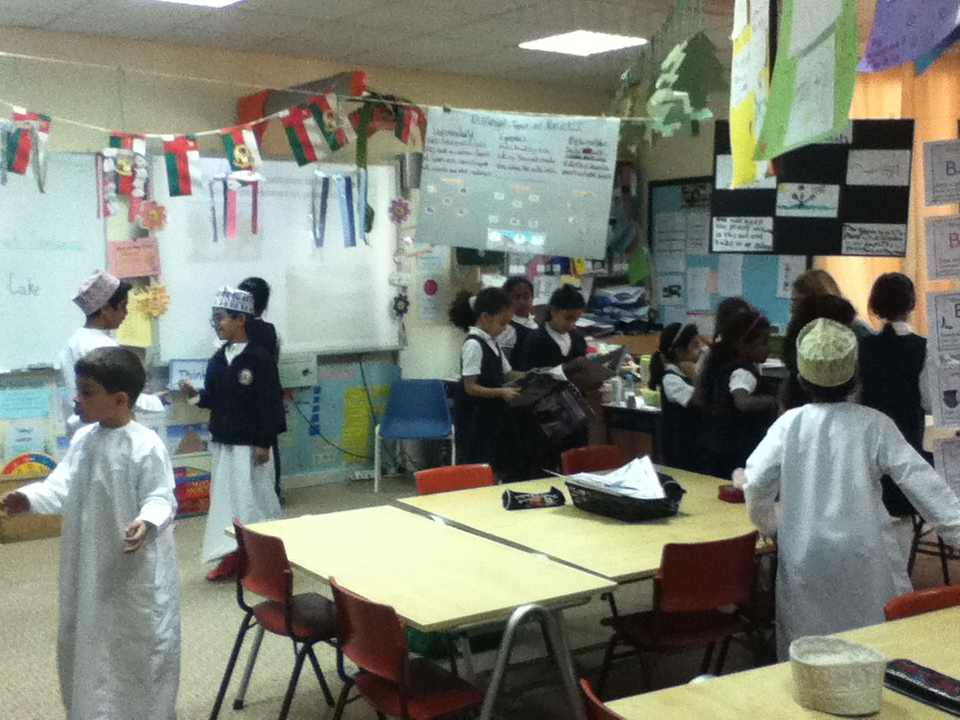
In third grade we do lots of writing exercises, they're learning cursive now, a skill whose purpose in 2013 I somewhat question; there's also many new adjectives to be had and the weird rules of English spelling. And they never fail to give me a full report on "Miss, I saw you in the car park" or "Miss, you were in Al Fair the other day," and anywhere else they saw me, so ya know, my heart melts.  
In first and second grades it's a lot of controlled chaos and the breaking up of arguments over Justin Beiber's religion, it's one of many hotly debated topics. It's interesting to note how much more Arabic is spoken among the kids in these classes, since about half of the students are just beginning to learn English. I'm happy to report that my Arabic has officially graduated to first-grade level, as I can understand their arguments just fine. Here are some of them, chasing bubbles, because when you're in 1st grade, you get to do that in class. 
It's fantastic experience in the realm of figuring-out-what-I-want-to-be-when-I-grow-up. And it's more fun than Economics. 

Saturday, February 2, 2013

RC44: perspectives from someone who wasn't supposed to be there

At first I was mad at this guy for ruining my shot, but then I decided that he just makes it look that much more official
Some of you may know that I've recently taken up sailing lessons, it's all a part of my plan to travel the world crewing rich people's sailboats, a plan just as  viable as the one involving hitchhiking to North Dakota and becoming a 1950s diner waitress. It's gonna happen.  

There's not much else exciting to say about that and I have no pictures because every time we go out there's a 50/50 chance I'll capsize, odds to which I don't care to trust my ipod. I apologize for completely mangling that last sentence in an attempt to not end it in a preposition. What I do have something to say about is the sight I walked out into after my lesson this past week. The outside of the nice-but-normal-looking-sailing-place had been transformed into fancy-pants-private-yacht-club-event-thing. 
Historically, Omanis have been sailors, the character of Sinbad is said to have originated from here, and ancient Oman built some pretty badass boats. So in modern times, The Sultan and Omanis have decided that sailing is like their thing. There's been a huge push to revitalize interest in it, for students to learn how to sail (which is why I have the opportunity to take lessons in the first place) and for Omanis to become more competitive worldwide as sailors. And thus, fancy-pants international sailing competitions happen here to try to attract more attention for the sport. 
It reminded me of the VIP section at Merriweather, when the concerts decide to get all classy (lol, okay try). Like any good event there were white cabana tents housing bite-sized hors d'oeuvres, ample numbers of tanned people in polos, and a short woman running around with a clipboard yelling at people to do their jobs. Every event staff has one. (Hi Lisa! Please let me work at Stand 6 this summer!) 

I idled around for a bit, only moderately fitting in among the white-linen clad racing crews and their entourages, making a mental note to one day worm my way into a sailing crew entourage. After ogling the boats and team Italia for a bit, I decided I should probably not make my ride wait any longer and wandered out of the elite-world-within-an-elite-world. I guess I'll never know who won. 

Wednesday, January 30, 2013

A Word on Omani Time

Fun fact, after searching for and failing to find any pictures pertaining to time, I just went downstairs and took a picture of our dining room clock, which gives you a sense of how long it took me write this post.
One thing that varies drastically among cultures is the concept of time. "Meet me at noon" means something different in New York City than in Berlin, Bangkok, or Barcelona. In Oman it means, why the heck would we meet at noon?? I'll be staying inside where there's A/C thank-you-very-much. 

Back home, I'm not exactly known as the most punctual person, to put it mildly. But I have nothing on the Omanis, where procrastination is basically a norm. Even public holidays (think the equivalent holidays of Labor or President's day) aren't officially announced until days before they happen. Until a few days ago, I had no idea whether or not I would have today off of school, even though everyone knew that a holiday was supposed to happen sometime around now. The Muscat Festival, a big month-long Columbia-Festival-of-the-Arts-esque shindig hypothetically begins the end of this month, but apart from a few sponsor signs, there has yet to be any kind of schedule published. 

And, it works. Sure, it's difficult to plan ahead, but then you realize, the problem isn't that it's difficult, it's that you're trying too hard to plan ahead. In Oman, I've learned that I'll save myself a lot of strain and frustration by just doing as the Omanis do, being spontaneous and going with the flow. And by assuming that any plans that are made will commence a good 1-2 hours after the agreed-upon time.