Showing posts with label Oman. Show all posts

Thursday, March 14, 2013

How to practice Arabic when everyone speaks English

Thanks to my beautiful, totally-not-coerced models Lisa and Ashley
To be honest, sometimes practicing Arabic can be embarrassing, frustrating, and feel totally futile. I often wonder, as I'm surrounded by Omanis speaking perfect English, if I'll ever have linguistic ability above the level of a 5 year old. But if I ever want to stop embarrassing myself with my Arabic, I need to start embarrassing myself with my Arabic more often--that's what this post is about. 

1. Greet people with a Salam Alaykum

Seeing that you're a foreigner, most Omanis will automatically speak to you in English, and it's so easy to go along with it. But returning a "How are You?" with "7umdililah, kayf 7alik?" shows the other person that you want to make the effort, opening the door to a bi-lingual conversation.


2. Practice with shopkeepers
It's much easier to talk to people who are impressed that you know any Arabic at all, so that even though your words are stunted, laboriously produced, and poorly formed, at least they find it cute that you're trying. An uncrowded stall in Muttrah or local coffeeshop are good places to strike up a conversation. But be careful that the person you're chatting with actually speaks Arabic (dishdashas are a good indicator)---one of the funniest scenes I ever saw in Muttrah was caused by a British tourist, wearing a one of those hilarious sexist-joke T-shirts and what looked like the European conception of a "Turban" wrapped around his head. It was around the time that a cruise ship had dropped anchor and unleashed its inhabitants on the old souq. He lumbered into the shop and began speaking loud, formal Arabic at the Bangladeshi store owner--a sad case of assuming brown person = Arabic speaker. Don't be this guy. 

3. Practice with taxi drivers
Oman is one of the few countries in the world where taxi drivers are nations--it's actually a law here. Car rides are good opportunities for low-pressure conversations; it's not too hard to say "I need to go here, take the next right, go straight" etc, and you can always get a driver talking about their family or how much they hate their job. Girls here won't have much opportunity for contact with taxi drivers because the official word is that "taxis are dangerous," but I've had some very entertaining conversations with Talal and Sayid, the highly emotional drivers who take us to after-school classes. 

4. Practice with kids
It's way less intimidating to carry on a conversation with a six year old than with a sixteen year old. Your vocabularies are much closer in scope, and kids are much more accustomed to communicating through pointing. That being said, kinder-gardeners have no qualms about mocking hilarious American accents, but if you're really internalizing criticism from humans who still eat their own boogers, you probably need to reevaluate your life. 

5. Read subtitles
Reading TV subtitles can make even the most boring parade of B-movie romcoms on MBC entertaining. The Arabic they use is very formal, so most of it makes no sense as a translation of casual conversations. Through subtitles I've learned the exclamation "Taban leka!" and other, equally useful phrases. 

Tuesday, February 26, 2013

Las Vegas of the Middle East

Of all the cities I've seen, Dubai is the shiniest. It screams "Look at me! I'm the ____-est!! I have lots of blinking lights!" The buildings are a mishmash of styles and imaginations, like if a crayon skyline came to life, rising out a the desert, completely disregarding its context. 
It was a fun weekend, and my host family was nice enough to invite along some of the YES girls to come with us. As a group of twelve people (my host family, the YES girls, my host aunt and miscellaneous cousins) we were about the size of a "normal" Omani family.  
The first place we went was the Old Souq, and what I found most interesting there was this sketch-looking alleyway. 
Well, not exactly the alley, but the neat little museum that we found at its end, buried inside the maze of Arabizi nick knacks that is Dubai's Old Souq.
It was devoted to a famous old Emirati poet, whose house had been converted into the museum. I honestly didn't spend much time reading his poetry (it was in Arabic) but the house was huge and fun to explore. 
This photo reminds Hannah that museums for dead poets aren't exactly Dubai's biggest draw, and that she probably ought to touch on those things as well.
We also did the customary Dubai-y type activities like mall-ing
And they were sufficiently ginormous, not that any of my photos capture that.
And fountain-ogling 
 (Photos that don't suck are courtesy of my host dad)
And giving out valentines to random strangers. Since we went over Valentine's Day weekend, and the city has enough foreigners that we didn't think anyone would be horribly offended, we decided to spend the day giving out cards to lonely-looking-turned-confused-looking people. 
A very nice weekend.  

Saturday, February 16, 2013

Is Justin Beiber Muslim? And other important questions

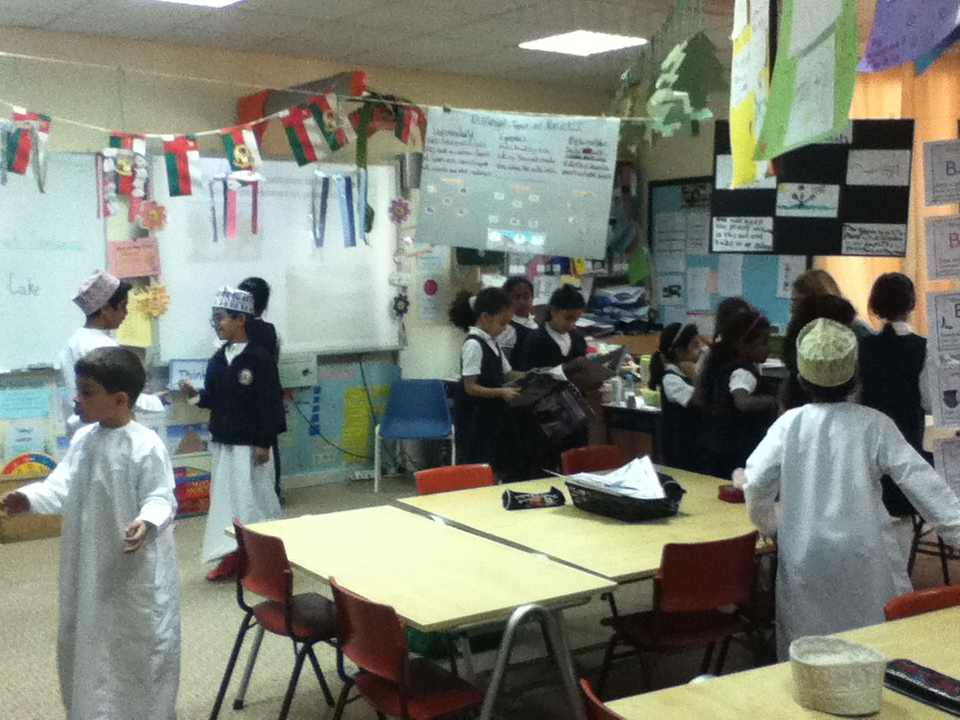
As an gap-year student, my school here had basically no clue what to do with me. I spent the first couple months auditing a bunch of classes that, while interesting (Economics is equal parts wonderful and terrifying; it lures you in with liberal-arts-friendly human behavioral patterns and then BAM. Math.), were basically a review for a test I wasn't going to ever take. So I asked a bunch of people if I could instead read books with kids all day, and they said, sure, we have no idea what you're supposed to be doing here anyway. 

The guys pictured pictured below I've been working with the longest. They're known as the 'scholars' because they come from the interior, living and studying at the school on a scholarship.This means that they're wicked smart but not used to learning in all-English, so they get extra ESL classes to bridge the gap.
 I spend most of my time asking them what they think of a book, prodding out full sentences and proper grammar. Right now we're reading about the first expeditions to reach the South Pole; it includes such hi-lights as "the dogs were our good friends, and now they are our good food" and disgruntled Englishmen writing letters to their mothers about how disgruntled they are. Riveting stuff. But their commentary makes it entertaining.

In third grade we do lots of writing exercises, they're learning cursive now, a skill whose purpose in 2013 I somewhat question; there's also many new adjectives to be had and the weird rules of English spelling. And they never fail to give me a full report on "Miss, I saw you in the car park" or "Miss, you were in Al Fair the other day," and anywhere else they saw me, so ya know, my heart melts.  
In first and second grades it's a lot of controlled chaos and the breaking up of arguments over Justin Beiber's religion, it's one of many hotly debated topics. It's interesting to note how much more Arabic is spoken among the kids in these classes, since about half of the students are just beginning to learn English. I'm happy to report that my Arabic has officially graduated to first-grade level, as I can understand their arguments just fine. Here are some of them, chasing bubbles, because when you're in 1st grade, you get to do that in class. 
It's fantastic experience in the realm of figuring-out-what-I-want-to-be-when-I-grow-up. And it's more fun than Economics. 

Saturday, February 2, 2013

RC44: perspectives from someone who wasn't supposed to be there

At first I was mad at this guy for ruining my shot, but then I decided that he just makes it look that much more official
Some of you may know that I've recently taken up sailing lessons, it's all a part of my plan to travel the world crewing rich people's sailboats, a plan just as  viable as the one involving hitchhiking to North Dakota and becoming a 1950s diner waitress. It's gonna happen.  

There's not much else exciting to say about that and I have no pictures because every time we go out there's a 50/50 chance I'll capsize, odds to which I don't care to trust my ipod. I apologize for completely mangling that last sentence in an attempt to not end it in a preposition. What I do have something to say about is the sight I walked out into after my lesson this past week. The outside of the nice-but-normal-looking-sailing-place had been transformed into fancy-pants-private-yacht-club-event-thing. 
Historically, Omanis have been sailors, the character of Sinbad is said to have originated from here, and ancient Oman built some pretty badass boats. So in modern times, The Sultan and Omanis have decided that sailing is like their thing. There's been a huge push to revitalize interest in it, for students to learn how to sail (which is why I have the opportunity to take lessons in the first place) and for Omanis to become more competitive worldwide as sailors. And thus, fancy-pants international sailing competitions happen here to try to attract more attention for the sport. 
It reminded me of the VIP section at Merriweather, when the concerts decide to get all classy (lol, okay try). Like any good event there were white cabana tents housing bite-sized hors d'oeuvres, ample numbers of tanned people in polos, and a short woman running around with a clipboard yelling at people to do their jobs. Every event staff has one. (Hi Lisa! Please let me work at Stand 6 this summer!) 

I idled around for a bit, only moderately fitting in among the white-linen clad racing crews and their entourages, making a mental note to one day worm my way into a sailing crew entourage. After ogling the boats and team Italia for a bit, I decided I should probably not make my ride wait any longer and wandered out of the elite-world-within-an-elite-world. I guess I'll never know who won. 

Wednesday, January 30, 2013

A Word on Omani Time

Fun fact, after searching for and failing to find any pictures pertaining to time, I just went downstairs and took a picture of our dining room clock, which gives you a sense of how long it took me write this post.
One thing that varies drastically among cultures is the concept of time. "Meet me at noon" means something different in New York City than in Berlin, Bangkok, or Barcelona. In Oman it means, why the heck would we meet at noon?? I'll be staying inside where there's A/C thank-you-very-much. 

Back home, I'm not exactly known as the most punctual person, to put it mildly. But I have nothing on the Omanis, where procrastination is basically a norm. Even public holidays (think the equivalent holidays of Labor or President's day) aren't officially announced until days before they happen. Until a few days ago, I had no idea whether or not I would have today off of school, even though everyone knew that a holiday was supposed to happen sometime around now. The Muscat Festival, a big month-long Columbia-Festival-of-the-Arts-esque shindig hypothetically begins the end of this month, but apart from a few sponsor signs, there has yet to be any kind of schedule published. 

And, it works. Sure, it's difficult to plan ahead, but then you realize, the problem isn't that it's difficult, it's that you're trying too hard to plan ahead. In Oman, I've learned that I'll save myself a lot of strain and frustration by just doing as the Omanis do, being spontaneous and going with the flow. And by assuming that any plans that are made will commence a good 1-2 hours after the agreed-upon time. 


Sunday, January 27, 2013

Adventures in Desert Camping

Adventures where exactly, I'm still a little fuzzy on. It was the desert, and there were mountains. In Oman, I'm pretty sure. 
All pictures of any quality are courtesy of Outward Bound Oman 
Words like "Wahiba Sands" "Wadi Abyad" and "Desert" have been thrown around, and I was told that "Where exactly are we hiking?" was a "Great question, I'll get back to that," but no one ever really got back to it.

From what I've pieced together, we were around Wadi Abyad, or the Abyad Desert. Abyad means white in Arabic, but everything was distinctly tan-colored, so, more mysteries there I guess.  
I looked it up in a guide book when I got home, and  think we were here-ish
We spent two nights backpacking, a group of fourteen including the YES kids, Omani YES alums, and students from the Access program (another State Dept program that sponsors ESL classes all over Oman). We went with Outward Bound Oman, an organization that does hiking trips and wilderness learning-y events for schools, corporations and the like. So there were lots of trust exercises. 

Oman has so much crazy-awesome wilderness, the chance to get out and explore it was wonderful. Hiking up and down dunes was a new and challenging experience, as the ground basically swallows your foot every time you take a step. But our dunes were pretty beginner-sized and quite a bit of fun to slide down if you didn't mind getting sand in your everywhere. 
Stopping at the top of a dune to shake off the sand
The second day we stopped at the Wadi, which was possibly the most beautiful sight ever after kilometers of sweaty hiking. 


We also got pretty up close and personal with some camels that belonged to Bedouins who live in the area. 
Just chillin with the camel, nbd
I enjoyed most was getting to know the alumni and Access kids. Many of them were from outside Muscat and it's always interesting to hear about Oman from different perspectives. I learned some new Arabic words  (Claire, what's the Omani word for goa--HOSH it's hosh, I know this one!) and learned a bit more about life outside Muscat. I think what this trip and others have really driven home for me is how much there is about Oman I still don't know. After 5 months, I may feel like I've gotten my little Muscati bubble figured out, but I'm dying to experience life in the dakhlia (lit. the interior) of which I have no real firsthand knowledge. Inshallah, we'll see if I can convince anyone to send me there :) 

Sunday, January 20, 2013

I have become a Tea Person

They say that studying abroad will change you, but I never expected to have my fundamental beliefs so rocked to the core. At the beginning of the exchange, they had us sign a contract promising that we would not make any "life changing decisions" (seriously, I can show you the paper) but I'm afraid I have broken that covenant, both with Amideast and myself.

It's partly due to the sore throat I've been nursing the past couple days, partly to the fact that my host family does wonderful things like growing lemon grass in the side garden and boiling fresh ginger in a real teapot, and partly to the fact that coffee made in a french press is just not the same. 
As you can see, we have drunk all the lemongrass,  and this is all that remains. Or this is some other dying plant in the garden, I'm not very good at identifying these sort of things.
Today I did a visual survey of the various tea paraphernalia around the house, to see if I was being subconsciously brainwashed. 


The evidence speaks for itself, my friends. And the evidence gives a resounding YES. 

I apologize to my family, to my friends, to my community, to anyone who ever thought me a person of principle. I ask you to please accept the person I have become, as difficult as it may be to understand, this is what living in Oman has done to me. 
=P

Friday, January 18, 2013

The Family "Farm"

One of the things I like most about Oman is how connected extended families are, family is always visiting, or  being visited, and many people count their "cousins" as close friends (Omani cousins are pretty loosely defined, there's not really any distinction made between the child of your parent's sibling and a 4th cousin-twice-removed, regardless of the convoluted line of relation, everyone is either and Aunt, Uncle, or cousin.)

Every Friday (the Omani equivalent of Sunday) my family has dinner with our Aunt and cousin, and occasionally we go over to the family "farm." Most families have a communal "farm" or misraah, where they get together for family reunions, holidays, and parties. For the Bahlanis, the misraah hosts a mini family reunion on Fridays, and different families drop in and out throughout the day. It's technically owned by my host Dad's older brother, but the whole family pitches in to keep it up. It might seem confusing to American sensibilities to have an entire house just for family gatherings, but in Oman, they happen so often it's just practical. 

Okay, so the term "farm" is somewhat misleading, while they do have a vegetable garden and some chickens,  it's more "house with lots of land" than "farm."


The farm also features this epic-ly massive tree, of which I've yet to take a satisfactorily good picture. It's beautiful. 
The green spaces are always filled with kids running around playing football and the house is usually atwitter with laughs from aunts and cousins, poking fun at one another like only family can. It's a good time, even though I only can understand a small portion of what's going on, as it's usually happening in Swahili or Arabic. 

Friday, January 11, 2013

Being an American

This picture is as American as it gets 
Living in the Middle East as an American is kind of like being from a notorious mob family. Sure, you're not in with the bootleggers and whatnot, and you know lots of family members who aren't, but eventually, your baggage is going to come up in conversation. Because everyone knows about that cousin of yours with a penchant for for assassinating world leaders, or crazy Uncle George, who killed a bunch of people and who's kind of the reason everyone hates your family in the first place. Sometimes they're embarrassing, a lot of the time they make terrible decisions, but, they're family, so you end up apologizing for them and feeling inexplicably defensive when someone says something negative about them, even when it's true.

It's a weird phenomenon that some of us exchange students have noticed, that we've become strangely more patriotic since coming to Oman. It's not like we were anarchists before (I'm pretty sure...) but I think personally that there's just a level of cynicism that comes with being a left-leaning politically-and-globally-aware young person. It's almost a form of homesickness, or the old adage "absence makes the heart grow fonder," that we remember the good things about the States now that we've been removed from it.  

I've never been (am certainly still am not) someone who buys into the whole "America--best country in the world" idea. That sort of thinking has no place in an increasingly interdependent global society, and the US has a long way to come in order to realize that. BUT, what living abroad has made me realize is that every country has issues. Some more than others, and I'm not saying that living in Oman has made America look good by comparison, not by a long shot. But problems in America are not uniquely American problems. 

Yes, in the US there is rampant ignorance and hypocrisy, yes money has our political system in a stranglehold, but every country has these issues to some extent or another, and if I have a problem with that I should be doing something to change it. So while it might be easier to pretend I'm Canadian, I'd rather make the effort to change perceptions about Americans abroad and to combat ignorance within the US--that's what the YES program is all about. I'm not blindly proud of my country, but I am committed to it; I believe that I can be a part of the change to make America a country of which many more people can be proud. 

Thursday, January 3, 2013

Musandam

As I mentioned in my last blog, my host family took a vacation over the winter break to that little part of Oman at the very North of our edge of the Arabian peninsula, the part that is actually separated from mainland Oman by the UAE. But the region was far too fascinating to be serviced by two photos and a few sentences, so here's some extra musings. 
The first thing you notice in Musandam are the mountains. By the sea, they look like this tired old men, worn smooth and grey by time, who have all slouched sideways for a short nap as they gaze out on the aquamarine waters. The slanting striations which uniformly cover the towering rock for miles really make you realize how the whole mountain range is all one piece, slowly pushing against other tectonic plates for eons, one which somebody decided one day to tilt 30 degrees instead of letting it standing up straight. 

Then there are the mountains more in the interior, the ones which are partially responsible for making it difficult to travel from Dibba to Khasab. While maybe not the prettiest mountains, they're certainly impressive; up close, they're soaring piles of grey-tan ruble, barren of vegetation other than low-lying shrubs and trees. 
No one was home, but someone definitely still lives here for at least part of the year
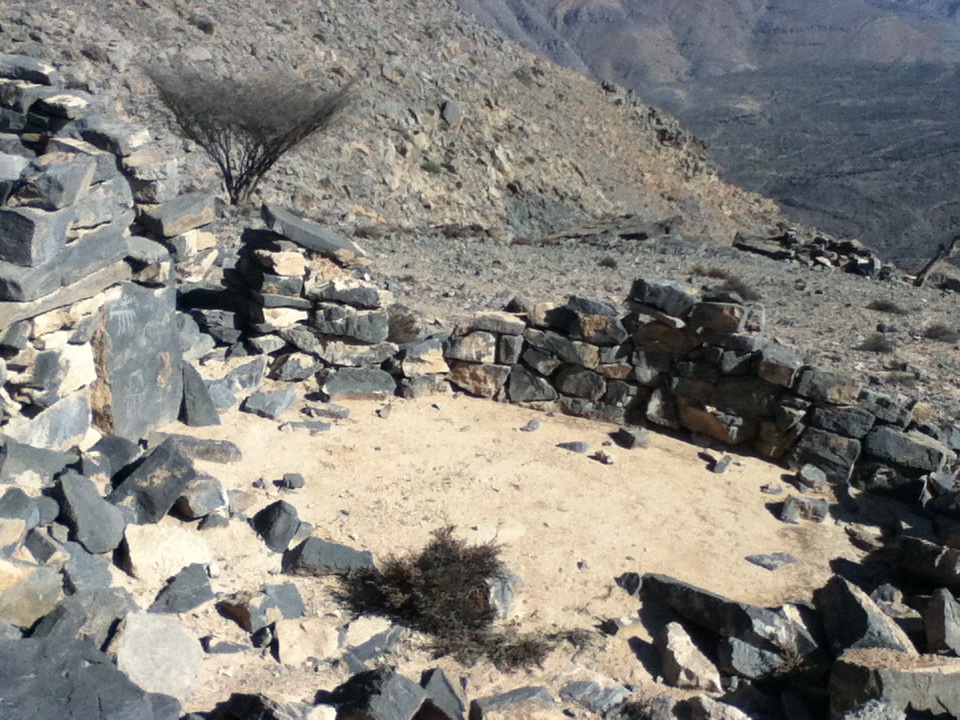
What's really amazing are the houses and villages dotting the peaks, even in this stark landscape, people have been living in the mountains for centuries, mainly goat herding but every now and then you'll see some terrace farming. Of course, not everyone decides to keep living in the mountains for generations. As we jostled through the the mountains on a one-lane dirt road, we found the remains of a stone housing compound, one which probably housing a mid-sized extended family.

I have no clue how old these foundations were, my host Dad thought they might have been abandoned in the 70s-a decade of much change in Oman-but no one can say for sure. One has to wonder though, what causes a whole community to abandon their home? What's the tipping point? Greater opportunity at the foot of the mountain? In the Emirates? Where did they go? All they leave us to ponder are a few knee-high walls of stacked stone where buildings once stood and a small burial plot. 

It's actually really strange to find any sort of inscription on a gravestone in  Oman, we're not sure why this one had a picture when the rest were blank.